1942年的夏天,第二次世界大战的阴霾笼罩着全球,纳粹针对犹太人的“最终解决方案”正在欧洲血腥推进。在纽约上州宁静的萨拉纳克湖(Saranac Lake)畔,63岁的阿尔伯特·爱因斯坦正在此避暑。然而,哪怕是在这片远离战火的湖光山色中,这位科学巨匠也无法真正获得片刻的宁静。每天,大洋彼岸的求救信如雪片般飞来。
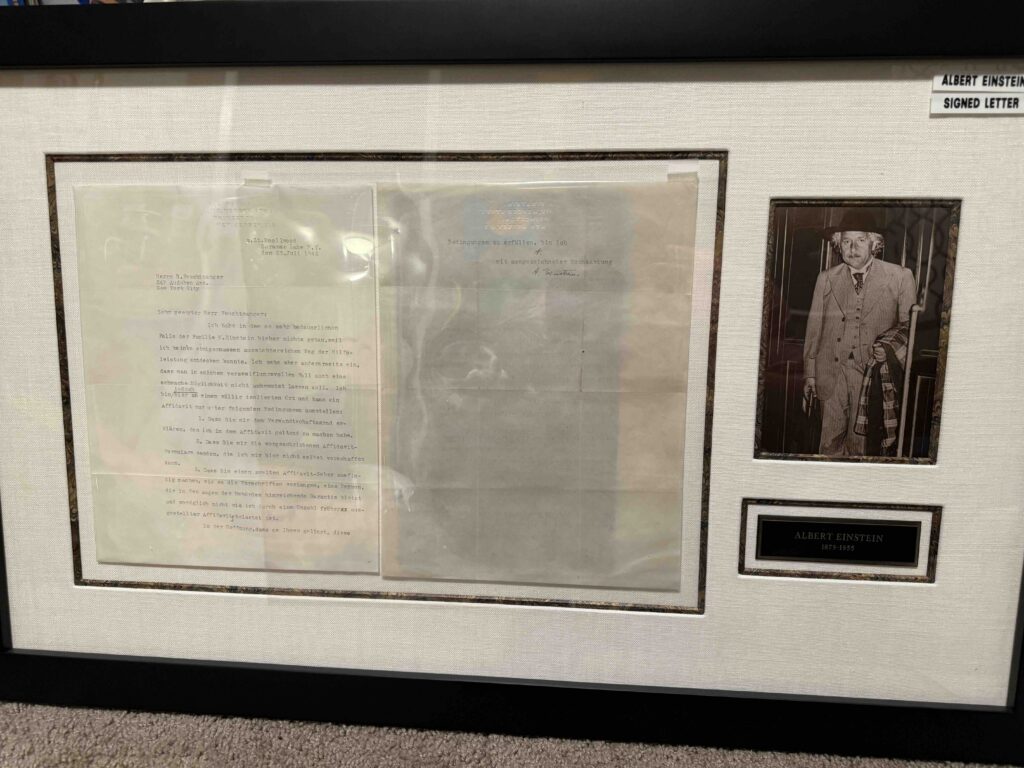
在“东方雅藏 (Oriental Elegance)”的馆藏中,静静陈列着一封签署于那个夏天的德语亲笔信函(TLS)。它跨越了八十余年的岁月,纸张已微微泛黄,却宛如一枚时空胶囊,将我们拉回了那个令人窒息的历史现场,揭开了爱因斯坦在面对同胞生死时,极其私密且令人动容的“英雄之困”。
浏览藏品:爱因斯坦(Albert Einstein) 1942 年二战救援亲笔签名信函
时空的拓片:无色钢印与双重签名
这封信的物理特征,本身就是一段生动的历史叙事。
凑近凝视这页信纸,最上方并没有印刷的油墨,而是压印着精致的无色钢印(Blind Embossing):“A. EINSTEIN, 112, MERCER STREET, PRINCETON, NEW JERSEY”。这是爱因斯坦最著名的普林斯顿故居专用信纸。
而在这行充满学术威严的钢印下方,爱因斯坦亲自用打字机敲上了一行小字:“z.Zt. Knollwood, Saranac Lake N.Y., den 25. Juli 1942”。德语“z.Zt.”意为“目前暂居”。这个细节生动地还原了历史的切片:爱因斯坦带着普林斯顿的私人信笺来到了萨拉纳克湖度假,但他的打字机却从未停歇。在这座孤立的避暑木屋里,他依然在彻夜处理着远方的生死呼救。
信件末尾的落款更是透着一种郑重与急切。爱因斯坦不仅用黑褐色的钢笔墨水签下了标准的全名 “A. Einstein.”,还在正上方独立、醒目地手写了一个起笔字母 “A.”。这种极其罕见的“双重签名”,仿佛是他在绝境中按下的一枚沉甸甸的印记。
流亡者的网络与“经济担保”
这封信的收信人,是 S. 福伊希特万格(S. Feuchtwanger)——欧洲著名流亡作家利昂·福伊希特万格(Lion Feuchtwanger)的家族宗亲。在那个血雨腥风的年代,流亡欧美的欧洲知识分子与艺术家们拼尽全力,在暗网般的绝境中构建了一张跨洋互助网。
他们通信讨论的核心,是关于营救滞留欧洲的 “M. Einstein 家族”(爱因斯坦的家族亲戚)。
1942年,想要将犹太难民从纳粹的魔爪下抢夺出来,唯一的合法生路是获得前往美国的签证。而签证的绝对前提,是有一位美国公民提供具有法律效力的 “经济担保宣誓书”(Affidavit),以个人资产向美国政府保证,难民入境后绝对不会成为公共负担。
在信中,爱因斯坦向这位同在流亡救援网络中的同伴沉痛地写道:“关于 M. Einstein 家族那个极其令人遗憾的案子,我此前一直未采取任何行动,因为我觉得找不到任何一个稍微有些希望的援助途径。但另一方面我也认识到,在如此绝望的境地(hopeless situation)中,即便是一线微弱的可能也不应该置之不理。”
随后,他务实而严苛地列出了签署这份救命文书的三个条件:必须查明具体亲属关系、必须寄来官方表格,以及最核心的第三条——必须找到“第二位担保人”。
隐秘的注脚:一位人道主义者的“透支”
正是这第三个条件,隐藏着这封信中最震撼人心的历史真相。
在德语原件中,爱因斯坦要求福伊希特万格去寻找第二位共同担保人,他给出的理由是:此人必须能在当局眼中提供充分的担保,“并且最好不要像我一样,已经因为签发了大量早前的担保书而身背重负” (und womöglich nicht wie ich durch eine Anzahl früherer ausgestellter Affidavits belastet ist)。
“身背重负”(belastet / burdened),这个词是整件文献的灵魂。
它撕开了历史宏大叙事的一角,让我们看到了一个真实、疲惫却依然不屈的爱因斯坦。在此之前,为了拯救无数素昧平生的犹太同胞,他已经竭尽所能地签发了大量的担保书。在当时的美国移民局眼中,他名下的经济担保额度早已严重“透支”,他的名字甚至可能因为担保人数过多而引起了官僚系统的审查警觉。
在公众眼中,他是高高在上的科学巨匠,但在那间避暑小屋里,他只是一个耗尽了个人信用与资产、在冷酷的官僚壁垒前濒临极限的普通老人。
但他放弃了吗?并没有。既然自己一个人的签名已经不够分量,那他就务实地指导同伴去寻找身家清白的“第二担保人”来凑足法定额度。即使身处完全孤立的地区,即使深知大环境令人绝望,他依然在绞尽脑汁地寻找变通之法,为远方的亲属争取最后的一丝生机。
永恒的坐标
如今,这封信安然地陈列在东方雅藏的展柜中,被顶级的博物馆级装裱妥善保护。信件旁,配有一张时期吻合的老照片:爱因斯坦拿着标志性的烟斗,手臂上搭着旅行毛毯,站在门前。
当后人凝视这份档案时,他们看到的不仅仅是一个被炒作的名人签名,而是一份带着体温的生死文书。那力透纸背的普林斯顿钢印,那深沉氧化的双重签名,以及那句充满疲惫与坚韧的“身背重负”,共同交织成了一首关于同理心、责任感与人道主义的悲怆交响曲。
它静静地诉说着:在人类文明跌入最深渊的1942年,曾有这样一位老人,竭尽全力地试图在无尽的黑暗中,多点亮一根火柴。
A Glimmer in the Dark and a Great Man’s “Burden”: The Life-and-Death Rescue Behind a 1942 Albert Einstein Letter
In the summer of 1942, the shadow of World War II loomed over the globe, and the Nazis’ “Final Solution” was bloodily advancing across Europe. By the tranquil shores of Saranac Lake in upstate New York, 63-year-old Albert Einstein was taking his summer retreat. Yet, even amidst this peaceful scenery far from the flames of war, the scientific giant could find no true peace. Every day, pleas for help flew in from across the ocean like snowflakes.
Resting quietly within the collections of Oriental Elegance is a German-language typed letter signed (TLS) from that very summer. Spanning over eighty years, the slightly yellowed paper serves as a time capsule, pulling us back to that suffocating historical scene and revealing the deeply private and moving “hero’s dilemma” Einstein faced when confronted with the life-or-death struggles of his compatriots.
The Topography of Time: Blind Embossing and a Double Signature
The physical characteristics of this letter form a vivid historical narrative of their own.
Leaning in to examine the page, one notices the top bears no printed ink, but rather a crisp, blind-embossed stamp: “A. EINSTEIN, 112, MERCER STREET, PRINCETON, NEW JERSEY.” This was Einstein’s renowned personal stationery from his Princeton residence.
Beneath this line of academic authority, Einstein personally typed a small notation: “z.Zt. Knollwood, Saranac Lake N.Y., den 25. Juli 1942.” The German abbreviation “z.Zt.” stands for “currently residing at.” This detail vividly recreates a slice of history: Einstein had brought his personal Princeton stationery to his vacation at Saranac Lake, yet his typewriter never rested. In that isolated summer cabin, he worked through the night, processing life-and-death pleas from afar.
The signature at the bottom conveys a sense of solemnity and urgency. Not only did Einstein sign his standard full name, “A. Einstein.”, in dark brown fountain pen ink, but directly above it, he independently and strikingly penned an initial “A.” This exceptionally rare double signature feels like a heavy seal pressed down in a moment of desperation.
The Network of Exiles and the “Financial Affidavit”
The recipient of this letter was S. Feuchtwanger, a relative of the prominent exiled European writer Lion Feuchtwanger. During those blood-soaked years, exiled European intellectuals and artists in the Americas fought desperately to weave a transoceanic mutual-aid network through an almost impenetrable darkness.
The core of their correspondence was the rescue of the “M. Einstein family” (relatives of Einstein himself) stranded in Europe.
In 1942, the only legal lifeline to snatch Jewish refugees from the clutches of the Nazis was securing a visa to the United States. The absolute prerequisite for this visa was an “Affidavit”—a legally binding financial sponsorship provided by an American citizen, pledging their personal assets to guarantee the refugee would not become a public charge upon arrival.
In the letter, Einstein wrote with heavy sorrow to his fellow rescue network member: “Regarding the very regrettable case of the M. Einstein family, I have done nothing so far because I could not discover any somewhat promising path of assistance. On the other hand, I realize that in such a desperate situation, a slight possibility should not be left unutilized.”
Consequently, he laid out three pragmatic and strict conditions for signing this life-saving document: the exact familial relationship must be clarified, official forms must be sent, and, most crucially, a “second sponsor” must be found.
The Hidden Footnote: A Humanitarian’s Exhaustion
It is this third condition that conceals the most profoundly moving historical truth of the letter.
In the German original, Einstein requested Feuchtwanger to find a co-sponsor, giving the reason that this person must be able to offer sufficient guarantee in the eyes of the authorities, “and possibly not, like me, burdened by a number of previously issued affidavits” (und womöglich nicht wie ich durch eine Anzahl früherer ausgestellter Affidavits belastet ist).
“Burdened” (belastet)—this word is the very soul of the document.
It tears away a corner of the grand historical narrative, revealing a real, exhausted, yet unyielding Einstein. Before writing this letter, in his desperate bid to save countless Jewish compatriots he had never even met, he had already issued an overwhelming number of affidavits. In the eyes of the U.S. immigration authorities at the time, his financial sponsorship quota was severely “overdrawn,” and his name might have even triggered bureaucratic scrutiny due to the sheer volume of his sponsorships.
In the public eye, he was an untouchable titan of science; but in that summer cabin, he was merely an ordinary old man who had exhausted his personal credit and assets, pushed to the absolute limit before a cold bureaucratic wall.
Did he give up? He did not. Since his signature alone no longer carried enough weight, he pragmatically guided his associate to find a financially unburdened “second sponsor” to meet the legal quota. Even isolated in a remote area, and even fully aware of the desperate climate, he still racked his brain for workarounds, fighting for a final sliver of survival for his distant relatives.
An Eternal Coordinate
Today, this letter rests peacefully in the display cases of Oriental Elegance, carefully preserved within top-tier museum-grade archival framing. Beside the document sits a period-correct photograph: Einstein, holding his signature pipe with a travel blanket draped over his arm, standing before a doorway.
When future generations gaze upon this archive, they will see more than just a hyped celebrity autograph; they will see a life-and-death decree that still carries the warmth of human touch. The deeply embossed Princeton stamp, the heavily oxidized double signature, and that exhausted yet resilient phrase “burdened”—together, they weave a tragic symphony of empathy, responsibility, and humanitarianism.
It quietly tells a story: In 1942, as human civilization plummeted into its deepest abyss, there was once an old man who did everything in his power to strike one more match in the endless dark.